

The world is facing a quiet but escalating crisis. As the global population ages, Alzheimer’s disease and other dementias are becoming increasingly prevalent, casting a long shadow over patients and their families. Currently, about 8% of adults over 65 live with dementia, while an even larger group—nearly 18%—experiences Mild Cognitive Impairment (MCI), often a precursor to the disease. This means roughly one in four older adults may be on the cusp of significant cognitive decline.
Alzheimer’s disease accounts for about 60% of all dementia cases. Traditional medicine, however, has primarily focused on patients who are already symptomatic, offering limited tools and few accessible treatments. For many families, a diagnosis brings more questions than answers, leaving them wondering, “We know it’s Alzheimer’s… what’s next?”
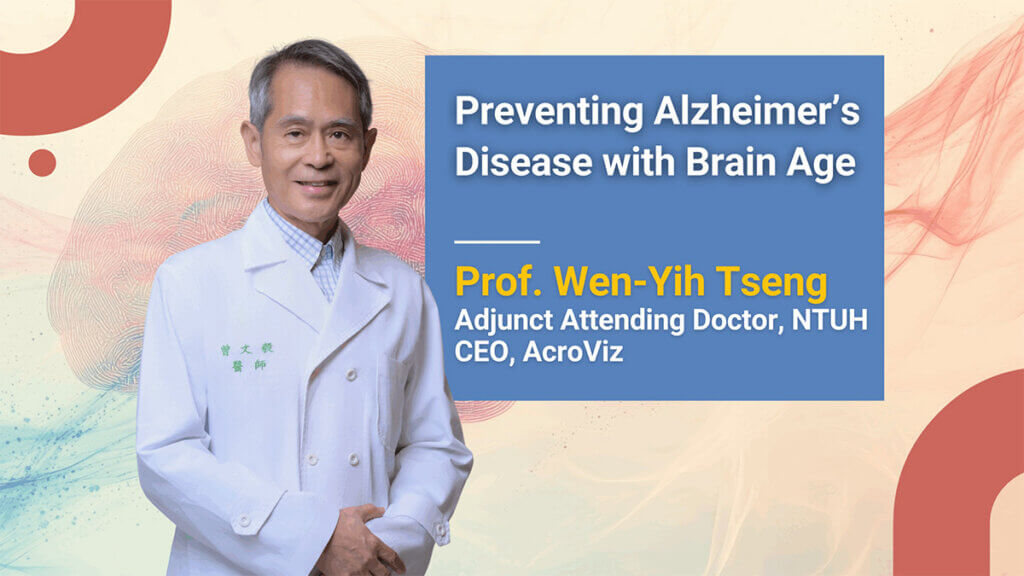
“By the time dementia is diagnosed, it’s often too late,” says Dr. Wen-Yih Tseng, an Adjunct Attending Doctor at National Taiwan University Hospital and CEO of AcroViz. “That’s the fundamental limitation of conventional medicine. Researchers are now asking if we can intervene earlier, ideally at the MCI stage. But an even more fundamental question is: how healthy is our brain to begin with?”
How Water Molecules Map Brain Health
Dr. Tseng and his team are pioneering a novel approach using diffusion MRI (dMRI) and artificial intelligence(AI) to calculate a metric they call “brain age.” The goal isn’t to diagnose dementia but to answer a more profound question: How resilient is your brain?
The brain’s neurons connect via axons, which are insulated by a protective myelin sheath. Dr. Tseng uses a simple analogy: think of an axon as the filling in cable and the myelin as the wrapper. This myelin “wrapper” is critical for protecting nerve fibers and ensuring that neural signals travel quickly and efficiently. The integrity of this myelin can be measured by observing the movement of water molecules along the axons.
In healthy brain tissue, the myelin sheath restricts water molecules, forcing them to move directionally, much like cars in a one-way tunnel. But when myelin degrades due to age or disease, water begins to diffuse more randomly in all directions. Researchers quantify this diffusion using two key dMRI metrics:
- Fractional Anisotropy (FA): Measures the directionality of water movement. Higher FA indicates healthier, more organized white matter.
- Mean Diffusivity (MD): Measures the overall movement of water. Lower MD suggests healthier tissue with stronger restriction to diffusion.
“In group-level studies, patients with dementia show clear differences in FA and MD compared to healthy controls,” Dr. Tseng explains. “But for an individual in the earliest stages, like MCI, these changes are incredibly subtle and almost undetectable. That’s the core diagnostic challenge.” This is why diagnosing MCI often requires invasive spinal taps or expensive amyloid PET scans, while reliable blood tests are still under development.
Brain Age: A New Window into Resilience
To overcome this challenge, Dr. Tseng’s team developed an AI model trained on a brain imaging database of thousands of healthy individuals, from adolescence to old age. By analyzing the FA and MD patterns in a new scan, the algorithm can predict a person’s “brain age.”
If the predicted brain age is within five years of a person’s chronological age, their brain is considered to be aging normally. However, a brain age that is significantly older than its chronological age could signal accelerated aging and increased vulnerability.
“This approach shifts the focus from disease to health,” Dr. Tseng notes. “Traditional medicine asks, ‘Where is the pathology and how do we eliminate it?’ We ask, ‘How strong and resilient is the brain itself?’”
This concept is known as brain resilience—the brain’s capacity to maintain normal function despite accumulating damage. It explains why some people can have significant Alzheimer’s pathology, like amyloid plaques, in their brains but never show clinical symptoms. Their neural plasticity and ability to form new connections act as a protective buffer.
“Brain age doesn’t measure the severity of the disease,” he clarifies. “It measures the resilience we have to withstand it.”
Brain Age From Research to Real-World Impact
Dr. Tseng’s group validated their brain age model using the OASIS-3 dataset, a large public repository of brain scans from healthy individuals and patients with MCI and dementia.
Their findings were significant: among patients with MCI, those who later progressed to dementia had a much older brain age at their initial scan. Conversely, patients whose condition remained stable or even improved tended to have a younger brain age.
“This confirms that brain age is not a diagnostic tool,” Dr. Tseng emphasizes, “but it is a powerful risk stratification tool. It helps doctors and families prepare, whether that means implementing lifestyle changes, planning for future care, or considering earlier medical interventions.”
The concept also has implications for evaluating treatment effectiveness. In a collaboration with Taipei Medical University Shuang-Ho Hospital, the team found that patients with a younger brain age responded more favorably to cholinesterase inhibitors, a standard dementia therapy. This suggests brain age could help predict which patients are most likely to benefit from new-generation drugs like Lecanemab and Donanemab.
“If the neurons are already gone, the drug has nothing to act on,” Dr. Tseng explains. “Keeping the brain young and resilient is the best insurance policy for ensuring future treatments can work.”
Prevention First: Building a Resilient Brain
With several new Alzheimer’s drugs finally entering the market, or pipeline which are developed, many are hopeful that a cure is near. Dr. Tseng, however, remains cautiously realistic.
“Dementia is not one disease but a multifactorial condition. Targeting amyloid plaques addresses one part of the mechanism, but it’s not the whole picture. A true cure will likely require combination therapies in the future.”
Until then, he stresses that prevention and resilience are our most powerful tools. “We can’t choose our genes, but we can choose our lifestyle,” he says. Simple preventative measures, like getting vaccinated against shingles, can help prevent viral infections known to damage brain tissue. Furthermore, interventions like mindfulness-based stress reduction, combined aerobic and cognitive training, and personalized wellness programs can all help preserve brain resilience.
Dr. Tseng concludes with a message that is both pragmatic and philosophical:
“Do your best, and leave the rest to fate. We may not be able to stop Alzheimer’s entirely, but we can face it with the healthiest brains possible.”

Gene Online: https://www.geneonline.com/fighting-alzheimers-disease-with-a-younger-brain-the-science-of-brain-age-and-resilience/